

Basic Policy (Brother Group Principles of Social Responsibility)
In 2012, the Brother Group Principles of Social Responsibility was formulated to clearly define our corporate responsibility and actions toward achieving a sustainable society.
Sections on, for example, respect for human rights, human rights due diligence, and grievance mechanism were established in this set of principles, which expresses the fundamental principles of the responsibilities and actions of companies in the Brother Group. It clearly states that we will provide fair working conditions, handle everyone with faith and respect, and observe fundamental human rights, and we expect our employees to act in the same way.
Overview of the Brother Group's commitment for respecting human rights
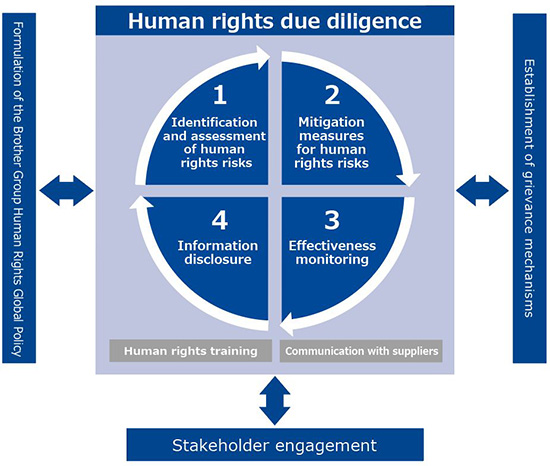
Brother Group Human Rights Global Policy
Brother Group respects the human rights of all people involved in the business activities of Brother Group, and actively engages in measures to ensure that our business activities do not have a negative impact on human rights.
In order to continue to work towards the advancement of human rights, we have formulated the Brother Group Human Rights Global Policy (hereinafter, the "Policy").
1-Scope of application
This Policy applies to all officers, employees, part-time employees, expatriate employees, temporary employees, and contract workers of Brother Group. In order to ensure that the measures described in this Policy extends to the whole of the value chain, Brother Group shall, either directly or indirectly, request that the people who are involved in our group's products and services would understand the Policy and cooperate with surveys, audits, and other measures outlined in the Policy.
2-Respecting human rights
Brother Group respects the human rights set forth in the International Bill of Human Rights and the International Labor Organization (ILO) Declaration on Fundamental Principles and Rights at Work and works towards the advancement of human rights based on the Guiding Principles on Business and Human Rights endorsed by the United Nations Human Rights Council.
In case there is a difference between the internationally recognized standards on human rights and the laws and regulations of each country or region, Brother Group will adopt the higher standard of the two, and in case there is a conflict between those standards, Brother Group will follow the laws and regulations of each country or region, while pursuing ways to respect the internationally recognized human rights to the greatest extent possible.
*Human rights issues that are most important to Brother Group include the following:
- Non-discrimination and Non-harassment
- Fair and lawful labor practices
- Freedom of association
- Child and forced labor
- Health and safety at work
- Sanitation, food and housing
3-Human rights due diligence
Brother Group is aware of the effects that its business activities may have on human rights. For this reason, Brother Group has introduced, and will continue to implement a due diligence process to assess the negative impacts that its business activities may have on human rights.
In case where negative impacts on human rights are identified, Brother Group will suspend the business activities and transactions, strive to mitigate the negative impacts resulting from such activities, or implement other measures to correct or prevent recurrence of such negative impacts. Such measures will be monitored to ensure that they are implemented properly.
4-Relief mechanism
Brother Group will provide a helpline where people such as victims who are negatively affected by human rights within Brother Group's value chain can seek relief. The helpline is open to everyone, including those within and outside of Brother Group. At the helpline, Brother Group will maintain anonymity and confidentiality in order to protect those who raise their concerns.
5-Information disclosure / Consultation
Brother Group makes appropriate disclosures on its website and reports regarding its human rights due diligence policy and the measures taken to identify and remedy negative human rights impacts.
Brother Group will also engage in sincere consultation with relevant stakeholders regarding the impacts its business may have on human rights.
6-Trainings
Based on the Policy, Brother Group implements various training programs to prevent negative impacts on human rights.
Promotion Structure
The Brother Group has established the Sustainability Committee chaired by the Representative Director & President. The Responsible Value Chain Subcommittee is one of the subcommittees under this Committee and promotes Group-wide global efforts to ensure respect for human rights.
The Subcommittee formulates global human rights due diligence policies and implements human rights due diligence as its activities to ensure that the human rights of people involved in the Group's business are respected and to provide safe and secure workplaces for workers.
For details, please see "Management with an Emphasis on Sustainability -Promotion of Management with an Emphasis on Sustainability- Promotion Structure".
Human Rights Due Diligence
The Brother Group practices human rights due diligence to further promote its initiatives to ensure respect for human rights.
In our human rights due diligence process, we request our first-tier suppliers*1 to our main businesses to adopt appropriate human rights measures on their own and also to ask their upstream suppliers to adopt similar measures. By doing so, we aim to achieve responsible procurement throughout our entire value chain.
FY2025 Efforts
In FY2025, we reviewed our human rights due diligence process to further increase its effectiveness. Specifically, we shifted to an approach of identifying the human rights risks to be addressed as a priority and then narrowing down the scope of our survey to suppliers for which the impact of those risks is considered to be significant. Compared with conventional questionnaire surveys of all suppliers, this new approach allows us to conduct an assessment survey focusing more sharply on suppliers with highly significant risks and to adopt more efficient and effective follow-up measures.
We shifted to this new approach and identified human rights risks not only based on our knowledge obtained from past human rights risk assessments and corrective activities we had conducted as a member of the Responsible Business Alliance (RBA) but also in comprehensive consideration of the results of previous surveys and audits, third-party evaluations carried out by external experts, and other factors. This new approach is in accordance with the United Nations Guiding Principles on Business and Human Rights.
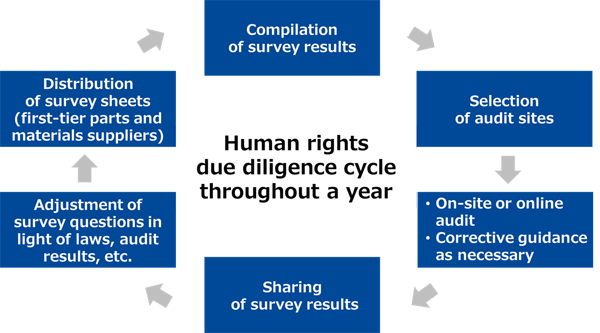
1. Identifying significant risk factors
To make its human rights due diligence process more effective, the Brother Group identified the following human rights risk factors it considered to be a high priority to address.
- Human rights governance
- Inadequate or unpaid wages; living wages
- Excessive or unfair working hours
- A safe and healthy work environment
- Rights of migrant workers
- Child labor
- Discrimination
- Freedom of association
2. Selecting suppliers to be surveyed (risk assessment) / 3. Designing a questionnaire
We assessed human rights risks at each supplier based on the significant risk factors identified at step 1 above and other factors, including the characteristics of the supplier's products and their manufacturing locations. Based on the assessment results, we selected suppliers with relatively high human rights risks to be surveyed. In addition, we optimized the questionnaire according to the characteristics of each supplier by, for example, including questions about the factors that require especially focused checks from among the significant risk factors identified at step 1.
4. Conducting a questionnaire survey and compiling the results
We conducted a questionnaire survey of the selected suppliers to confirm whether risk mitigation measures had been adopted, whether human rights violations had occurred, what initiatives had been implemented to prevent and detect such cases, and other matters. The survey revealed that there was room for improvement at some suppliers.
5. Conducting audits and corrective activities
We conducted online and on-site audits of suppliers assessed to require improvements. The audits did not identify any serious human rights violations or non-compliance with relevant laws or regulations that required immediate corrections. However, they revealed the need for further improvements in systems for acquiring and sharing the latest information on human rights risks, implementation of the risk assessment procedure, and safety and health measures. Based on these audit results, we provided various forms of support for each supplier's efforts in corrections and risk mitigation, including assisting them in formulating a correction plan.
Results of the questionnaire survey and audits of first-tier suppliers
| Item | Result |
|---|---|
| FY2025 | |
| Number of companies surveyed for risk assessment | 227 companies |
| Assessment based on survey | 101 companies*2 |
| On-site or online audit | 11 companies |
| Number of companies subject to correction after audit | 6 companies*3 |
![[Open PDF File]](/-/media/global/common/img/file/icon-pdf.ashx)
| Item | Result | |||
|---|---|---|---|---|
| FY2021 | FY2022 | FY2023 | FY2024 | |
| Assessment based on survey | 951 companies | 1,128 companies | 1,129 companies | 1,196 companies |
| On-site or online audit | 10 companies | 10 companies | 10 companies | 25 companies |
| Number of companies subject to correction after audit | 1 company*4 | 2 companies | 0 company | 1 company*5 |
- Suppliers mean companies that supply parts that are necessary for manufacturing Brother products.
- Number of suppliers that obtained lower risk scores than the average in the screening process and were assessed to require a more detailed factual investigation
- Subject to corrective measures mainly in the formulation and awareness of policies on prevention of human rights violations, as well as workplace safety
- Correction has been confirmed.
- Correction has been confirmed.
Grievance Mechanism
For all stakeholders: Establishment of a complaint reporting helpline
The Brother Group joined the Japan Center for Engagement and Remedy on Business and Human Rights (JaCER) in FY2022 and established a helpline (the link to the JaCER's website) where Brother Group suppliers, customers, investors, and all other stakeholders can raise specific concerns about human rights. This helpline allows anonymous reporting so that whistleblowers can report without fear of retaliation. When a report is received, we promptly investigate the case. In case negative impacts on human rights or human right risks are identified, we take necessary corrective action. One grievance was reported during the period FY2022 to FY2025.
For Officers and employees: Establishment of consultation and whistleblowing helpline (Employee Helpline for Compliance Issues)
At the Brother Group, Brother Industries, Ltd. (BIL) and group companies within and outside Japan have compliance consultation and whistleblowing helplines to prevent violations, act quickly against them, and take preventive steps against reoccurrences.
BIL has the internal Employee Helpline for Compliance Issues for employees to consult and report when they discover or suspect compliance violations, have issues which are not resolved even after reporting to and consulting with their workplace supervisors, or when they have issues which cannot be reported to or consulted with workplace supervisors due to inevitable circumstances. BIL has also established the internal Employee Helpline for Harassment Issues that is dedicated to harassment behavior—such as sexual and power harassment—in an effort to create workplace environments where employees can work while respecting each other. A Quality Compliance Helpline is also in place to prevent compliance and other violations related to the quality of products and services of the Brother Group and to respond to and correct any violations. In addition, an external helpline for compliance issues has also been established with affiliated lawyers outside the company to allow employees to directly report violations.
For details of the consultation and whistleblowing helpline, such as number of cases handled, please see the site for "Governance (G)- Compliance and Anti-Corruption- Brother Group Global Policy for Helpline for Compliance Issues".
Conduct of Training Related to Human Rights
The Brother Group conducts training related to human rights to prevent any negative impacts on human rights.
Human rights training for employees
From FY2021 to FY2024, BIL conducted an e-learning program on harassment for all employees. In FY2025, we conducted hazard prediction training for harassment prevention, applying the Japanese Kiken Yochi Training (KYT) approach, to help prevent harassment, promote its early detection, and encourage dialogue in the workplace.
| Training period | February–March 2026 |
| Target | All employees of BIL (including temporary employees) |
| Number of participants | 4,135 |
| Percentage of people trained | 92% |
| Purpose | To deepen employees' understanding of harassment and promote its prevention and early detection in the workplace |
| Overview | After watching videos introducing harassment cases in each workplace, participants discussed the cases with their colleagues and shared their insights and lessons learned |
In addition, we conduct training related to human rights, such as workshops on harassment, for management and managers (employees in senior positions) and training on Understanding Basic Human Rights related to basic knowledge about human rights for new employees.
Furthermore, in FY2025, we distributed books on harassment prevention to managers and also put up harassment prevention posters in the workplace. We also held a harassment prevention lecture by an external lecturer for newly appointed managers and general employees. Participants learned about what they can do to help prevent harassment and what kind of behavior constitutes harassment.
For details, please see the site for "Social(S)- Talent Development- Details of Education System and Training".
Respect for Human Rights for Suppliers
Brother Group's measures ("Procurement Policy" and "CSR Procurement Standards")
The Brother Group makes its "Procurement Policy" and "CSR Procurement Standards" publicly available to share its CSR procurement concept with parts and materials suppliers.
The policy and standards cover a wide range of fields, including human rights and labor, the rights to organize and bargain collectively, safety and health, global environmental protection, fair trade and ethics, product quality and safety, raw materials, information security, and social contribution. The Brother Group complies with local laws and regulations and supports workers' collective bargaining rights by conducting collective negotiations and respecting communication between management and employees on working conditions and management practices.
In the Procurement Policy, the Brother Group clearly states that we act fairly with all suppliers and take proactive approaches toward responsible procurement of minerals. In the CSR Procurement Standards, in addition to promoting understanding of the Brother Group Global Policy on Human Rights, we express our stance of respecting human rights in each stated item while requesting suppliers to cooperate in efforts to respect human rights in their procurement activities, as well as to establish a process to check the status of those efforts.
For details, please see the site for "Social(S)- Responsible Supply Chain".
Domino Group's Measures (Domino Supplier Code)
Domino Group establishes the "Domino Supplier Code"* which sets out expectations for its suppliers. The Domino Supplier Code stipulates human rights related matters such as prohibiting the use of child labor and forced labor, and is incorporated into contracts with its first-tier suppliers that are entered into upon commencing transactions. Furthermore, in order to confirm their ongoing compliance with the Code, Domino Group conducts a written survey for its first-tier suppliers once every two years.
- A policy setting out Domino Group's expectations for its suppliers. It covers the 4 key principles of treating people fairly, providing a safe and healthy workplace, protecting the environment, and behaving ethically, and is aligned with leading international global initiatives such as the United Nations Global Compact, International Labour Organisation (ILO) Conventions and Ethical Trading Initiative (ETI) Base Code.


